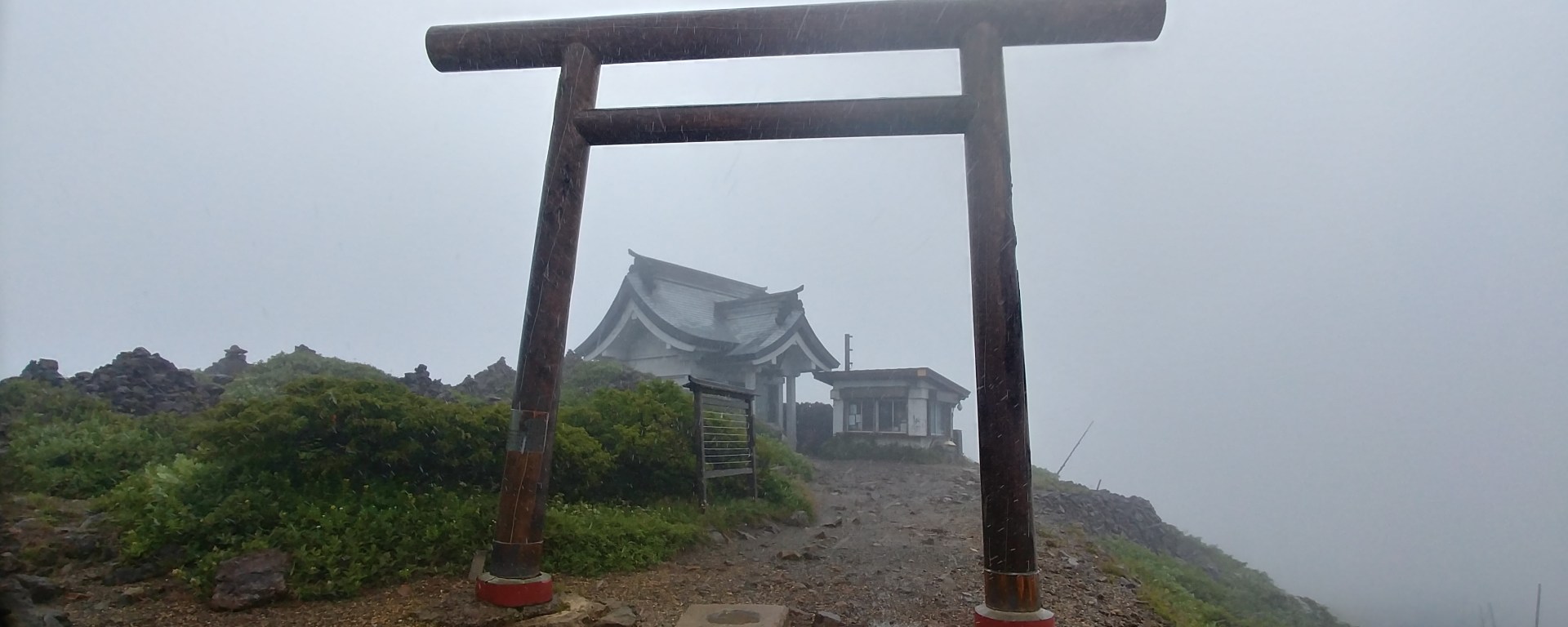
I’ll be totally honest with you: going to this shrine was really not the smartest thing I could’ve done.
This has nothing to do with the shrine itself, and everything to do with the fact that I visited it during a typhoon.
To this day I’m not sure why I went. Sure, I was a little restless, and more than ready to get out of the city. And yes, I definitely underestimated what a typhoon might feel like when it was me out there, feeling the full brunt of the elements, not the nice anchorwoman on TV. The only thing I can do now is claim momentary insanity.
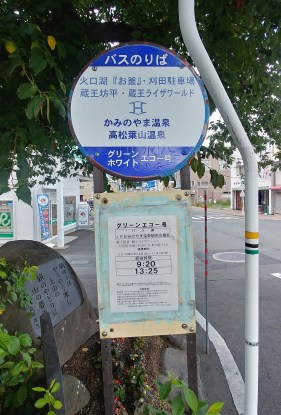
I think one of my favorite parts about heading so far out is not knowing what to expect. I was armed with a bare paragraph from Japanguide’s Kaminoyama page and some testimonials on various Japanese blogs that were light on the pictures and access information. I’ve learned that going in with no expectations also helps with having your expectations dashed when you do get there.
That said, on a normal day with no inclement weather, the ascent up the mountain might be long, but it would come with nice scenery. Going up on a ski chair is a little intimidating until you see how far you are from the ground (that is to say, it’s pretty close, so you might want to raise your feet). And I’m sure the autumn colors are beautiful given the right time of year.
But in reality…
…my ascent was intensely cold, as I was dressed in a light summer sweater with a 300 yen rain poncho thrown on. I huddled desperately over my backpack, vainly trying to keep it dry and to keep any body heat from escaping. The eight-minute ride seemed interminable. I barely paused to ask the operator at the top for directions – a suspect judgment call I attribute to being so thoroughly miserable.
“Do you think the shrine is in business today?”
“Shrine’s always in business, 365 days a year, rain or shine! Go right at the top of the stairs, but if you can’t tell where the path is anymore, just turn around. Don’t wander off in this fog, or else it’ll be the end for you!”
Gee, thanks. Feeling a bit more chilled to my bones, I dashed up the stairs in a vain attempt to generate body heat, then marched my way down the right-hand path.
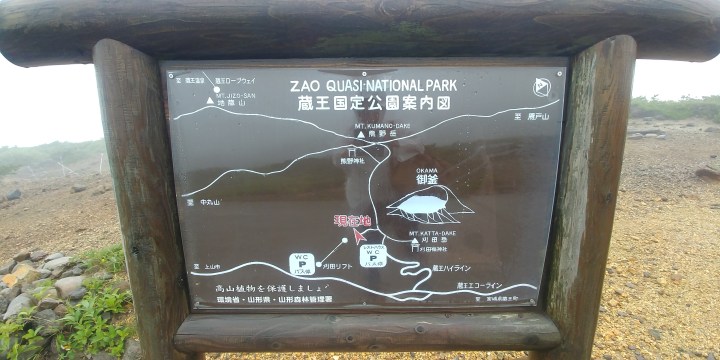
I was on a time crunch. The shuttle bus would leave a mere half-hour after I got to the top of the lift. Even though the map said it was only a ten-minute walk to the shrine, I wanted to give myself as much time as possible to get back.
Despite my trepidation, the path was well-marked with stones, though the path itself was pockmarked in places where gravel and dirt had shifted. I forced myself to ignore the cold, the pebbles that had somehow gotten kicked into my shoes, and how soaked through my socks were. There might be little more in the world I hate more than cold, wet feet.
A split in the road turned left towards the Oyama Crater, a picturesque mountain lake featured in countless guidebooks and postcards. It was completely hidden by the endless fog that rolled up the mountain. I only spared one regretful moment at the lookout, staring into the wall of solid white, before I moved on.
Three people in similarly poor quality ponchos directed me towards a sudden incline in the right-hand path. Here, the road alternated between a muddy slope and crude, wide stairs.
At the halfway point, I suddenly saw the shape of the torii gate in the gloom. The shrine loomed beyond it.
I finally arrived!
I was so distracted my brain only noted the basics: small white structure, chipped and peeling paint, half-open doors, faded collection box. No purification spring. As expected of a secondary shrine, I guess.
When I rang the bell, I also rained a miniature flood down upon my own head. It might have been the briefest prayer of my entire life.
To the right of the shrine was the shrine office and shrine goods counter. It looked completely dark and abandoned. I puzzled over the lack of doorbell or chime – common in the countryside where the shrine office is often located in a corner of the priest’s home – and then simply decided to knock.
Like a wraith, the priest materialized from where he had been below the table. My heart jumped to my throat for a moment, after which I wondered if he had done that so theatrically on purpose.
Hot air from an unseen heater billowed out into the cold when he opened the window. My request was simple: I wanted a shrine stamp. He looked sympathetic when he closed the window to complete his task; he probably thought I was cold, but my body was at that point where the numbness had set so far into my bones, I could no longer feel anything.
Our chat was brief, mostly about the weather. We both lamented how nothing was visible, and bought a commemorative postcard of the crater when it was visible from the shrine as a promise to return sometime. It wasn’t until later I realized the priest had slipped an ema (絵馬), a votive tablet, as a souvenir into my envelope, ostensibly in recognition of my difficulties getting up there.
Then came the return journey. The road was still as easy as I remembered it, and now that my shoes were soaked through, I didn’t care as much that I was tromping through puddles and slipping over rocks. I told myself if I did end up taking the shuttle bus down, I would reward myself with a nice bath at one of Kaminoyama’s famous hot springs.

And I did.
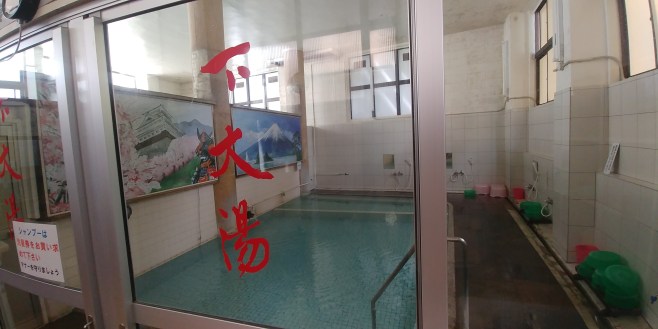
A glorious bath it was. I didn’t care if the Shimo Oyu Bathhouse (下大湯) was a public bath without any bells or whistles, or that it took five whole minutes to figure out how the faucet worked. It was blessedly steamy inside anyhow.
The actual pool was painfully hot – but I didn’t care. The water soothed the aches and pains from my rough-and-tumble mini-adventure, and I knew I would sleep soundly from this satisfyingly native romp into the wilds.
A little background history
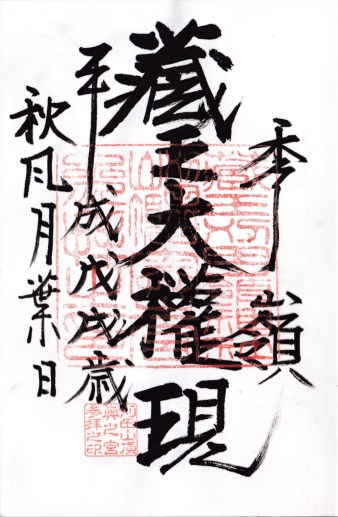
This remote shrine is the secondary shrine, or Okunomiya (奥宮) of the Kattamine Shrine located in the Zao Onsen area. (The main shrine is also larger.) It was deemed secondary because of how impassable the winter snows were, forcing pilgrims to visit the more centrally located main shrine (the Satonomiya (里宮)) instead.
Legend says an unnamed mountain was dedicated to Yamato (present-day Nara Prefecture) as a place for pilgrims to train their ascetic arts. It was then given the name “Zao”.
After some jostling during the Warring States period, this area ended up within the Date Family’s sphere of influence, and as a result, the Kattamine Shrine fell under Katakura Kojurou’s supervision. Presumably because Zao Kengen was the family’s guardian diety, Katakura ordered the shrine to be rebuilt every twenty-one years, a method modeled after the Ise Grand Shrine.
Basic information:
- Name: Kattamine Jinja (Okunomiya) (刈田嶺神社 (奥宮))
- Address: Shichikashuku, Katta District, Miyagi Prefecture, Japan (宮城県刈田郡七ヶ宿町)
- Google Maps plus code: 4CHX+46 Zao, Miyagi Prefecture, Japan
- Access: a free shuttle bus leaves a few times a day from the parking lot in front of JR Kaminoyama Station. From there you ride until the very last stop, the Katta Parking Lot, then take the ski lift to the top of the mountain towards Oyama Crater. Shrine is a ten-minute walk towards the right.
- Founded in: 679 (白鳳6)
- Annual festival: May 5th
- Deities enshrined: Ama-no-mikumari-no-kami (天之水分神), Kuni-no-mikumari-no-kami (国之水分神), Zao Kengen (蔵王権現)
- Benefits: protection from water-related disasters, good weather, conception, safety (水難守護、天候祈願、子授かり、安全祈願)
- Resources:
- Japanguide’s Kaminoyama Onsen
- Zao Liza’s free shuttle bus (蔵王リザ無料シャトルバス”グリーンエコー号”) (Japanese only)
- Zao Katta ski lift (蔵王刈田リフト) (Japanese only)
- Zao City information on Kattamine Shrine (蔵王町観光物産協会) (Japanese only)
(Visited 2018.5.5)
 Shrine Walker
One thought on “Kattamine Jinja (secondary shrine) – a relic of Miyagi’s legendary heros rises up through the fog”